
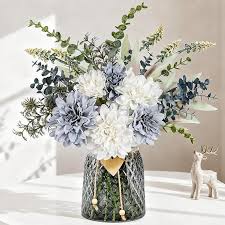
A floral arrangement can feel convincing from across the room and look less at home once it reaches the coffee table. Styling realistic fake flowers starts with choosing the right scale and placement, then giving the arrangement enough space to be seen. The goal is a believable part of the room, rather than an object that competes with everything around it.
Begin with the surface you want to decorate. Consider how close people will sit, which direction they will view it from, and what else needs to remain usable. Those details help narrow the choices before a particular bloom or vase catches your eye.
Match the Arrangement to the Viewing Distance
A piece placed beside a reading chair will be seen differently from one on a hallway console. For close viewing, examine the product images for petal edges, flower centers, leaves, and visible stems. Look for enough detail to understand the piece rather than relying only on a wide room photograph.
For a more distant placement, overall shape and proportion become especially noticeable. Compare the arrangement’s height and spread with the surface and the objects nearby. A small vase can disappear on a broad console, while a large arrangement may crowd a narrow shelf.
Read the listed dimensions carefully and check whether they describe the complete arrangement or just the container. If that is unclear, ask before ordering. A rough outline made with paper can help visualize the footprint without guessing from a styled image.
On a dining or conversation table, consider sightlines as well as appearance. Picture people seated around it and leave room for the table’s everyday purpose. An arrangement should not need to be moved out of the way every time the surface is used.
Choose a Flower and Container That Belong Together
Start with a flower shape you already enjoy. A compact rose arrangement creates a different outline from a taller orchid, while fuller blooms can occupy more visual space. Compare silhouettes before deciding on color so the arrangement suits the intended location.
The container contributes to the effect. Clear glass makes visible stems and the lower construction part of the display, while an opaque pot keeps attention higher. Examine the whole piece, including the base, rather than approving the flowers and overlooking what holds them.
Check whether the product is sold as a complete arrangement or as separate stems. A premade piece may have stems fixed in position, so do not assume they can be removed or transferred to another vase. If rearranging is important, confirm that flexibility in the product description.
Keep the surrounding materials in mind. A ceramic container may relate to nearby pottery, while glass can echo other transparent objects in the room. That relationship is a styling choice rather than a rule, but it gives the arrangement a reason to belong where it is placed.
Use Color and Spacing With Restraint
Choose a small group of colors already present in the room or introduce one deliberate accent. Compare the flower color with the wall, upholstery, and nearby decorative objects. A product photograph is useful for reference, but judge the delivered piece in the actual space before committing to its position.
Give the arrangement some breathing room. Try removing one neighboring object if the surface looks crowded. A simpler grouping makes it easier to appreciate the flowers’ shape and the container without filling every available inch.
Rotate the arrangement and view it from the normal approach to the room. If it has a more attractive side, use that angle where the placement permits. For a centerpiece seen from every direction, check the complete outline rather than only the view from one chair.
Before settling on a location, review a few practical details:
- The complete height and width fit the available surface.
- The container is stable and sits fully on the tabletop or shelf.
- The arrangement leaves everyday objects and sightlines accessible.
- The colors relate to the room without requiring every item to match.
- The piece looks considered from the directions people normally see it.
- The location follows the product’s stated indoor or outdoor use guidance.
Keep the Display Looking Considered Over Time
Unpack the arrangement carefully and follow any supplied shaping instructions. If stems or leaves are adjustable, make small changes rather than forcing fixed parts. Contact the seller when the construction is unclear instead of assuming every faux material can be bent or trimmed.
Use the recommended cleaning method for the product’s materials. Do not assume an arrangement can be immersed or sprayed because it contains no living flowers. The petals, coatings, adhesives, and container may require different care.
For outdoor placement, check the exact product’s use instructions and exposure limits. A general outdoor category should not be read as a promise that every item can remain in all weather indefinitely. Keep the setting appropriate to the piece selected.
Realistic fake flowers look more at home when scale, container, and placement are considered together. Explore arrangements from Fake Flowers with a specific surface in mind, then check the dimensions and care details before choosing. A well-placed piece with room around it can make a stronger impression than a larger display that overwhelms the space.