
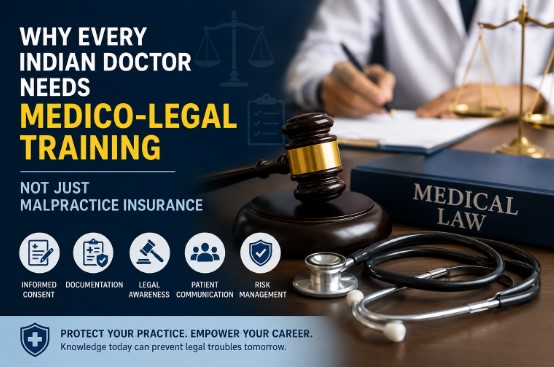
Ask most Indian doctors what protects them if a patient files a complaint, and the answer is often the same: professional indemnity insurance. It is an important part of risk management and, for many doctors, something that gets renewed each year and is rarely thought about again.
Professional indemnity insurance is undoubtedly valuable. But insurance alone was never designed to address every medico-legal risk a doctor may encounter.
Insurance primarily helps manage the financial consequences of certain covered claims after a problem has arisen. It cannot prevent a complaint from being filed, replace effective communication with patients, or correct inadequate consent and documentation practices.
In other words, insurance is one part of professional risk management. Medico-legal awareness is another.
The Real Trigger Behind Many Complaints Isn’t Always Clinical Error
This is an important distinction for healthcare professionals to understand: a medico-legal dispute does not automatically mean that the clinical treatment provided was negligent.
Sometimes, a doctor’s clinical decision may be medically defensible, but other factors can weaken the doctor’s position. These may include an inadequately documented consent process, medical records that do not clearly reflect the reasoning behind a decision, or patients and family members who feel they were not sufficiently informed as the clinical situation evolved.
India’s healthcare and medico-legal environment has also changed significantly. Patients today have greater access to information about their rights and more awareness of the mechanisms available for raising complaints about healthcare services.
For doctors, this makes communication, informed consent, and accurate medical documentation increasingly important aspects of responsible clinical practice.
A poor or unexpected outcome is not automatically evidence of medical negligence. However, when a dispute arises, clear records of what was discussed, explained, consented to, and clinically decided can become extremely important.
What Medico-Legal Training Actually Covers
Medico-legal training is sometimes misunderstood as an attempt to turn doctors into lawyers. That is not its purpose.
Practical medico-legal education is about helping healthcare professionals understand the legal and ethical responsibilities that directly affect their everyday clinical practice.
Depending on the scope of the training, this may include:
- Understanding the principles of informed consent and how consent discussions should be appropriately documented.
- Recognising the legal distinction between an adverse medical outcome and medical negligence.
- Understanding how consumer protection laws may apply to healthcare services in India.
- Developing awareness of how complaints may proceed through consumer commissions, civil proceedings, or professional regulatory mechanisms.
- Learning appropriate approaches to medico-legal communication and documentation.
- Building medical record-keeping habits that reflect clinical decisions, reasoning, patient communication, and follow-up.
- Understanding how to respond appropriately when a complaint or legal notice is received.
The purpose is not to replace professional legal advice. Rather, it is to help doctors develop enough practical awareness to identify potential risks, maintain appropriate records, communicate effectively, and seek specialist guidance when necessary.
Why This Matters More for Senior Doctors, Not Less
There is a common assumption that experience provides its own protection — that a doctor with twenty years of clinical practice has less need for medico-legal education than a resident or early-career physician.
But experience does not automatically translate into legal preparedness.
Senior doctors may manage higher patient volumes, complex cases, larger teams, and greater administrative responsibilities. At the same time, some communication and documentation practices may have been developed years earlier, while healthcare regulations, patient expectations, technology, and legal frameworks have continued to evolve.
As a result, medico-legal education can be valuable at every stage of a medical career.
For an early-career doctor, it can help establish good professional habits from the beginning. For an experienced practitioner, it can provide an opportunity to reassess existing practices in light of the current healthcare environment.
Prevention Is Better Than Defence
When a complaint arises, the quality of clinical care is naturally important. But the way that care was communicated and documented can also become highly relevant.
Was the medical record created contemporaneously?
Were significant risks and available alternatives discussed where appropriate?
Was informed consent obtained and properly documented?
Were changes in the patient’s condition communicated clearly?
Does the medical record demonstrate the reasoning behind important clinical decisions?
These are not questions that should first be considered after receiving a legal notice.
They are part of good everyday clinical governance.
This is why medico-legal education should ideally be viewed as an ongoing component of professional development rather than a one-time seminar attended only after a dispute occurs.
Just as continuing medical education helps doctors keep their clinical knowledge current, medico-legal learning can help healthcare professionals stay informed about the legal and ethical responsibilities surrounding their practice.
Closing the Gap Between Clinical Excellence and Legal Preparedness
Indian medical education is designed primarily to produce clinically competent healthcare professionals. However, doctors may receive comparatively limited practical exposure to the complex legal and regulatory situations they can encounter during their professional careers.
This creates a gap between clinical competence and medico-legal preparedness.
Closing that gap does not mean that every doctor needs to become a lawyer. It means developing enough practical legal awareness to recognise risks, communicate clearly, maintain appropriate documentation, understand professional responsibilities, and know when specialist legal advice is required.
Professional indemnity insurance will always remain an important component of a doctor’s risk-management strategy. But it should not be viewed as the entire strategy.
A more comprehensive approach combines appropriate insurance coverage with ethical practice, effective patient communication, informed consent, accurate documentation, regulatory awareness, and ongoing medico-legal education.
For today’s doctors, clinical excellence and legal preparedness should increasingly go hand in hand.
About the Author
Dr. Arvinder Singh is a postgraduate medical doctor with qualifications in medicine, management, and law, including MBBS, MD, MBA, and LLB. He is also trained in legal arbitration and commercial mediation and has over 25 years of experience in the healthcare industry.
He is the Founder of MedipreneurX, an online learning platform offering practical, expert-led education across areas including medical law, communication, leadership, artificial intelligence, and other future-ready professional skills.
Through MedipreneurX, Dr. Singh works to strengthen professional and medico-legal awareness among healthcare professionals. Doctors interested in deepening their understanding of medical law, ethics, informed consent, documentation, and legal risk management can explore this resource on medico-legal training.