 of oxygen are present in the gas stream,)
Natural gas is often thought of as a “clean fuel,” but when even a few parts per million (ppm) of oxygen are present in the gas stream, the consequences can escalate quickly — from equipment damage and chemical wear to safety hazards and regulatory issues. For companies operating in production, transportation, and gas-treating facilities, managing this often-overlooked factor is essential.
Here’s what industry professionals need to understand — and how Optical Oxygen Analyzer can help.
What Happens When Oxygen Enters the Gas System
When oxygen comes into contact with reduced sulfur compounds (like hydrogen sulfide or organic sulfur species), or when it mixes into treating chemicals, several harmful chains of reaction can start almost immediately:
-
Plugging and fouling – Oxygen promotes oxidation of sulfur compounds into elemental sulfur, which deposits in pipes, heat exchangers, valves, etc. These deposits restrict flow, increase pressure drops, and reduce throughput.
-
Acceleration of corrosion – Oxidation products like sulfur oxides (SO₂, SO₃), when combined with moisture, form acids (sulfurous, sulfuric) that degrade metal surfaces. Even stainless alloys can suffer under certain conditions.
-
Chemical performance decline – Oxygen degrades amine and glycol solvents, increases the formation of unwanted byproducts (e.g. heat-stable salts), reduces efficiency, and drives up operational costs.
-
Regulatory and environmental risks – More sulfur oxides being emitted, more chemical waste, more frequent maintenance; in many jurisdictions, this raises compliance concerns.
Common Points Where Oxygen Finds Its Way In
Here are high-risk zones where oxygen is likely to enter a natural gas system:
-
Tank Vapor Recovery Units (VRUs): Roof hatches, vent valves, or piping interfaces that aren’t sealed properly. Temperature swings or truck loading/unloading can cause pressure changes that draw air in.
-
Compressor packing and seals, especially on low-pressure wells: When suction pressures drop below atmospheric, worn seals or gaps allow ambient air entry.
-
Vacuum gathering systems: Underground pipes, flange joints, threaded connections; tiny leaks here are difficult to observe but can cause persistent oxygen ingress.
-
Processing plant operations: Start-ups, shutdowns, maintenance — especially when equipment is offline or being purged — can let in air pockets.
Monitoring: Catching Oxygen Early Matters
Early detection of oxygen presence is critical. Because oxygen is usually absent or at extremely low, stable background levels in clean natural-gas or hydrogen streams, even small spikes are strong indicators of air ingress. Monitoring brings several benefits:
-
Enables fast corrective action (seal fixes, increase inert gas purge, tighten controls).
-
Protects downstream units (amine or glycol systems) before the damage becomes expensive.
-
Helps maintain product quality, safety margins, and emissions compliance.
Technology Comparison: In-Situ vs Extractive Measurement
When selecting monitoring tools, the measurement method matters a lot:
Introducing the MOD-1040: Modcon’s Real-Time Oxygen Sensing Solution
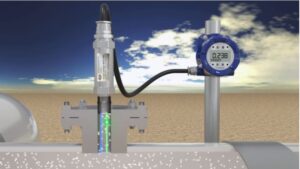
Modcon’s MOD-1040 Process Oxygen Analyzer is designed specifically to address the challenges of trace oxygen presence in natural gas systems. Here’s why it stands out:
-
Uses optical fluorescence quenching to detect oxygen levels below 1 ppm in real time.
-
Installed in situ, meaning the sensor measures directly in the process stream with fast, accurate feedback.
-
Built for harsh environments: certified for safety, robust against vibration, pressure changes, moisture, etc.
-
Helps operators spot oxygen ingress at vulnerable points (e.g., VRUs, compressor packing, vacuum gathering).
-
Enables proactive maintenance rather than reactive repairs.
-
Proven reliability in natural-gas and hydrogen operations.
Modcon AI: Turning Data into Decisions
While the MOD-1040 provides the critical oxygen measurements, Modcon AI transforms these data streams into actionable insights. Using advanced reinforcement learning and digital twin models, Modcon AI continuously optimizes process parameters to:
-
Minimize energy use by stabilizing treating unit performance.
-
Reduce chemical consumption through predictive solvent management.
-
Extend equipment life by proactively adjusting operations when oxygen spikes are detected.
-
Enhance compliance by ensuring sulfur-emission targets are consistently met.
Together, the MOD-1040 and Modcon AI shift oxygen management from reactive troubleshooting to proactive, optimized operation.
What Operators Gain (Besides Reduced Risk)
Investing in good oxygen control — and tools like the MOD-1040 — delivers returns in several areas:
-
Lower chemical usage and waste (less amine / glycol degradation).
-
Reduced unplanned maintenance and longer equipment life.
-
Fewer emissions and better regulatory compliance.
-
Improved safety margins.
-
Higher uptime and more stable operations.
The Bigger Picture: For Businesses & the Environment
In a time of increasing regulatory scrutiny around sulfur emissions, wastewater, chemical waste, and long-term infrastructure degradation, managing oxygen presence isn’t just a technical detail — it’s a business imperative. Further, as natural gas systems move toward hydrogen blending, the stakes are even higher: hydrogen-rich mixtures react differently, and safety margins shrink.
Call to Action
If your operation still relies primarily on periodic inspections or delayed sampling, now is the moment to invest in continuous, real-time monitoring. Learn more about how Modcon’s Optical Oxygen Analyzers can integrate into your existing systems, identify your system’s oxygen entry points, and help you improve both safety and profitability.