
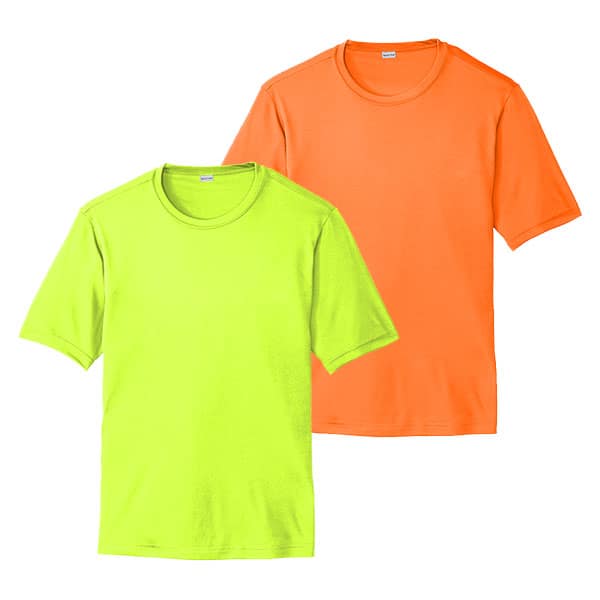
Conversations about safety apparel for holiday installation crews tend to focus on the outerwear: jackets, vests, the visible top layer. The base layer underneath gets far less attention and is often where program quality breaks down. A crew working through a December lift install or a busy warehouse staging operation will perspire heavily regardless of outside temperature, and the shirt against the skin determines whether that sweat moves away from the body or saturates the insulating layers and reduces them to wet weight. Specifying high visibility shirts dri-fit construction for the right roles addresses both visibility compliance and worker performance in a single garment.
Two Contexts Where Performance Shirts Belong
Performance high visibility shirts serve installation programs in two distinct contexts that ordinary cotton or basic polyester cannot.
The first is warehouse and indoor staging. Receiving, kitting, and pre assembly operations run in heated buildings where outerwear is impractical, but where forklift traffic, pallet movement, and reception bays still require high visibility apparel. A performance fabric shirt provides ANSI compliant visibility without the heat retention of a vest worn over a cotton shirt.
The second is the base layer under cold weather outerwear during outdoor installation work. Crews working physically demanding installs, even in cold weather, generate substantial heat and moisture under their jackets. A moisture wicking shirt as the base layer prevents the wet cotton problem that starts warm in the morning and ends cold by lunch.
What Performance Fabric Actually Does
Performance moisture wicking fabric moves perspiration away from the skin by capillary action through engineered fiber and weave structures. The sweat is transported to the outer surface of the garment where it can evaporate. Polyester blends are the most common base, sometimes combined with spandex for stretch.
The result, when done well, is a shirt that feels dry against the skin during physical work and that does not bunch or stick when the worker bends, reaches, or climbs. Compared with cotton, the difference becomes obvious within the first hour of demanding work.
The Cold Weather Sweat Paradox
Workers in cold weather face a counterintuitive problem. Heavy insulation traps body heat efficiently, but it also traps moisture from perspiration. A crew member who starts the morning warm in a cotton shirt under a quilted jacket will, after thirty minutes of lift work, be wearing a saturated shirt against the skin. Once the worker stops moving, that wet shirt becomes a heat sink that pulls warmth from the body rapidly.
Performance base layers solve this by keeping the skin dry through active periods, so the worker stays warm during the brief pauses between tasks. In a long workday, this difference compounds into measurable fatigue reduction and lower cold injury risk.
ANSI Class Compliance for Shirts
Performance high visibility shirts are available in Class 2 and Class 3 configurations under ISEA 107. Verify the same compliance markers as any other high visibility garment: documented background fabric area, properly applied retroreflective striping, and a manufacturer label citing the standard and class.
A common pitfall is assuming that any neon shirt qualifies as high visibility. It does not. Without the proper background area and reflective striping, a bright shirt is fashion apparel, not PPE.
Specifying by Role
Different crew roles call for different specifications. Indoor staging workers can usually wear Class 2 short sleeve performance shirts. Outdoor installation crews working under jackets benefit from long sleeve Class 2 base layers, with the outer jacket carrying the Class 3 compliance for the ensemble. Workers in roadway adjacent roles outdoors should wear Class 3 throughout.
Specify cut and length to accommodate movement. A shirt that pulls up at the waist during overhead work loses both warmth and visibility coverage.
Care, Longevity, and Inventory Planning
Performance fabrics do not tolerate household fabric softener, which clogs the moisture transport mechanism and degrades wicking performance over time. Bleach degrades fluorescent background pigments and should not be used. Industrial laundering protocols should be adjusted accordingly.
Inspect shirts at the end of each season for striping integrity, color fade, and seam wear. Retire and replace degraded inventory rather than carrying it forward. Installation companies that run year round operations often justify dedicated performance shirt inventory across all four seasons, since the same garments serve warehouse work, summer maintenance, and shoulder season installs.
Closing Thought
The right base layer is one of the highest leverage low cost decisions in a holiday installation PPE program. It improves worker comfort, supports visibility compliance, and meaningfully reduces the cumulative fatigue that drives end of season injuries.
For decorators, facility managers, and venue operators outfitting holiday installation teams, National Safety Gear carries ANSI compliant performance high visibility shirts in the sizes, sleeve lengths, and class configurations that varied crew roles require. Build the program from the skin out, and the outerwear will deliver on the protection it was designed to provide.