
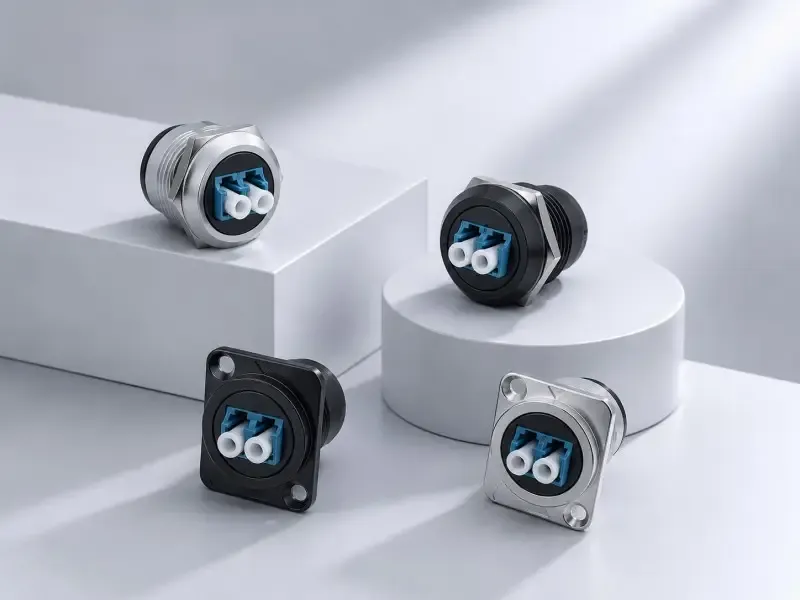
Pick up anything electronic near you and count the connectors. The charging port. The socket the charger plugs into. The ribbon between the board and the screen. A phone has maybe a dozen. A car has hundreds.
None of them were made by the company whose logo is on the outside.
An industry of small companies making tiny things
The connector business is one of the most fragmented corners of manufacturing. There’s a handful of giants, and then there are thousands of specialist factories, most of them making a narrow slice of the catalogue. One does circular waterproof shells. Another does audio. Another does nothing but the little board-to-board connectors inside laptops.
Small parts, small prices. A connector might sell for fifty cents. The factory makes money on volume and on not getting it wrong, because a connector that fails takes the whole product down with it — and the brand on the outside is the one that eats the return.
That asymmetry, cheap part and expensive failure, shapes the entire industry.
Why a fifty-cent part needs its own paperwork
Here’s the part that surprises people. That connector carries its own compliance file.
When a company certifies a finished product for sale in Europe or North America, the assessment doesn’t only look at the assembled thing. It leans on the certification of the components inside it, particularly anything touching mains power or providing insulation. A power inlet without the right approvals means the product it’s fitted into can’t be certified either.
So a supplier selling a fifty-cent part maintains test records, material declarations and approval files for it — the same categories of documentation a far more expensive product would need. This is a genuine barrier to entry, and it’s why the field of available suppliers narrows sharply the moment you’re building something you intend to sell rather than just use yourself.
Tooling is where the money actually is
If you’ve ever asked a factory for a custom version of something and been startled by the quote, this is the reason.
A connector body is injection moulded. The mould is a machined steel tool. It costs thousands of dollars and takes weeks to cut. Once it exists, each part that comes out of it costs cents.
So the economics are brutally simple: enormous fixed cost, near-zero marginal cost. That’s the whole explanation for minimum order quantities. An MOQ isn’t a supplier being awkward. It’s the number of units it takes for the tooling cost per part to stop being absurd. Ask for 200 custom parts and the tool cost lands on 200 units. Ask for 100,000 and it disappears into the noise.
It’s also why “just change it slightly” is expensive and “pick a different standard part” is nearly free.
What “ships to 70 countries” is really claiming
Export reach gets quoted a lot in this industry, and it isn’t only a size boast. Different markets want different things from the same part. Voltage and current ratings differ. Approval marks differ. Cable diameters differ, because the cable standards feeding into the connector differ.
A manufacturer like verchil, working across a wide export base, ends up carrying variants of the same product family that exist purely because of regional differences like these. It’s a decent illustration of why component catalogues are so much larger than they look like they ought to be.