
Efficiency has always been a defining marker of operational excellence. However, the next competitive advantage is no longer just about being leaner, but also about executing faster. AI is emerging as a major driver of this shift, reshaping how OPEX teams execute and scale improvement.
For decades, organizations have prioritized operational excellence as a competitive differentiator. Industry leaders have relied on frameworks such as Lean, Six Sigma, Business Process Management, and continuous improvement for squeezing costs, reducing waste and standardizing processes.
However, the frontier is now shifting. Top organizations today are not only leaner but also faster. So, speed of execution is becoming the new competitive differentiator, and AI is at the forefront of driving the change. OPEX no longer needs to be slow and time-consumingasit once was. AI is opening new possibilities by helping organizations close the execution gap.
The Traditional Bottleneck in OPEX
Operational Excellence has traditionally been slow, relying heavily on manual tasks and significant bandwidth from team members. Capturing process knowledge, creating process maps for thousands of processes in a single department can itselftake months. Stakeholder interviews, manual diagramming, and review cycles are all cumbersome, often making organizations spend considerable time, even before they reach the stage of analysis and improvement.
As organizations grow, they become more complex with distributed teams and expanding operations. OPEX teams often end up spending more time documenting rather than actual execution and outcomes.
Even after reachingthe analysis stage, teams can take weeks to identify improvements. Then again, there is a loop of approvals and feedback before actual implementation. This significantly extends the operational excellence timelines. As a result, many initiatives struggle to demonstratemeasurable results, causing projects to lose momentum or even stall.
How AI is Accelerating the Execution Model
AI changes the game for OPEX by bringing speed to the execution. Some advanced BPM tools now include AI agents that can take on much of the repetitive, diagnosticand documentation-heavy work, freeing OPEX teams to concentrate on value-added work. From process mapping and analysis to improvement and insight generation, AI takes away manual burdenfrom every phase and empowers OPEX teams to focus on execution rather than administration.
Fast-TrackingCurrent Process Capturing
Every operational improvement initiative begins with clarityon the current-state process. Historically, this stage has been time consuming. Workshops, interviewsand process reviews can take weeks or even months before organizations establish a reliable current-state view.
AI-powered BPM solutions can dramatically acceleratethis phase.
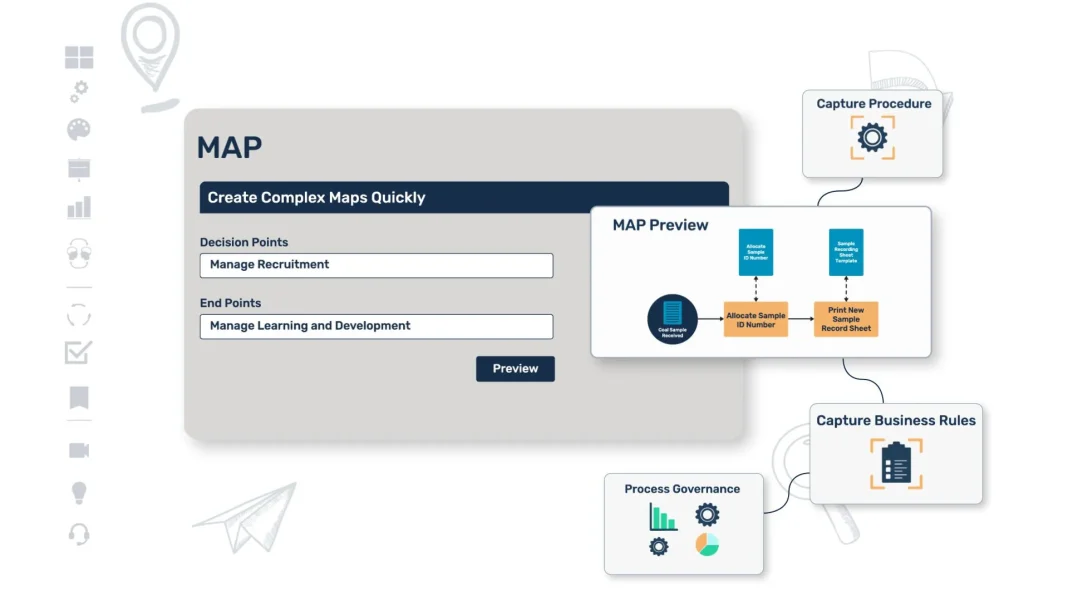
Next-gen AI agents can convert multiple forms of input, right from documents, spreadsheets, images, recordings, and conversations, into structured process maps within minutes. Further, built-in validation capabilities can identify missing steps, inconsistencies or logic gaps automatically.
This significantly reduces the time spent on manual diagramming, reviews and process mapping.
Turning Analysis into Real-Time Intelligence
The next stage in the OPEX lifecycle, analysis, is also marred by the challenges of skills, expertise and time required in identifying and validating improvement opportunities. AI brings automation to the mix, instantly highlighting delays, excessive handoffs, bottlenecks, manual intervention hotspotsand standardization gaps in the process. With AI-driven analysis, teams get immediate visibility into areas that require improvement, saving time and resources.
AI can also simulate alternative improvement scenarios before implementation, helping organizations evaluate risk, prioritize initiatives, and improve decision-making.
Embedding Operational Intelligence into Daily Work
One of the biggest challenges in Operational Excellence has beendriving staff adherence.Even when processes are documented and optimized, employees often struggle to access information quickly or apply it consistently during execution. Valuable process knowledge frequentlyremains trapped in repositories, disconnected from daily operations.
AI helps bridge this gap.It allows employees to get process guidance directly by chatting with the process data. With AI-powered chat interfaces, staff can ask in plain language and receive relevant insights based on their role, task, or situation, without navigating process documents. Apart from frontline staff, executives can access key decision-making insights, such as processes that are cost-intensive, highly manual or prone to compliance risks.
The Evolving Role of OPEX Teams
As AI becomes more integrated into operations, the role of Operational Excellence professionals is evolving. With AI taking over repetitive, manual tasks, OPEX teams need to shift their focus—fromdocumentation to execution, task management to actual results and periodic review to continuous improvement.
Contrary to common concerns, AI does not reduce the importance of human expertise. Instead, it amplifies it.Human judgment, leadership, and strategic thinking remain essential. Advanced Business Process Management software with AI today enhance these capabilities by removing non-value-add activities and accelerating execution cycles.
The organizations seeing the greatest impact are not replacing teams with AI. They are augmenting teams’ capabilities to operate at a higher level.
The Future of Operational Excellence
The era of AI as a competitive differentiator in OPEX is not coming. It’s here. The question is whether your organization is ready to embrace it. Organizations that can successfully combine human expertise with AI-driven speed, intelligenceand scalability will be best positioned to lead in the coming years.
At PRIME BPM, we are already seeing organizations explore AI-driven operational excellence execution to accelerate transformation and improve agility.Oganizations that wait for the technology to mature furtherriskbeing left behind. The companies that move now, not to implement AI for its own sake, but to systematically amplify execution and business outcomes,will gain the biggest competitive advantage