
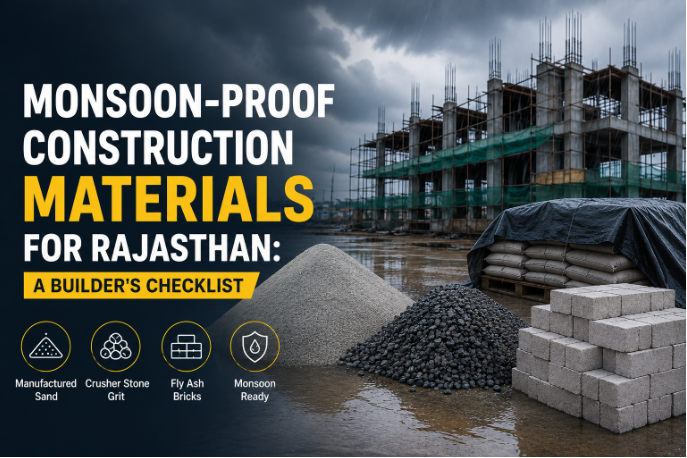
Monsoon-proof construction in Rajasthan means selecting materials — manufactured sand, crusher stone grit, fly ash bricks, and cemented solid blocks — that maintain consistent gradation, moisture resistance, and structural integrity through the June–September rain season, when ambient humidity, unpredictable water content, and supply disruptions all converge to test a project’s planning margins.
Monsoon season in Rajasthan is short but disruptive. Builders who don’t plan material selection around it end up with delayed pours, quality-compromised concrete, and rework that eats straight into margins. The rains last roughly 90 days. The problems they cause — if materials and protocols aren’t in place beforehand — can extend a project timeline by far longer than that.
Getting material choices right before the season starts is cheaper, by a wide margin, than fixing problems after the rains hit.
According to the Bureau of Indian Standards, concrete quality during monsoon is significantly affected by excess free moisture in aggregates, which directly shifts the effective water-cement ratio beyond what site engineers account for in their mix design. That’s not a minor calibration issue — it’s a structural one.
Why Material Selection Changes During Monsoon
Excess moisture affects everything from sand consistency to curing time. The variables that builders manage comfortably during Rajasthan’s long dry season become actively problematic once humidity rises and rainfall introduces uncontrolled water into aggregates, cement storage, and freshly poured concrete.
The core challenge is variance. During dry months, moisture content in aggregates is low and relatively stable — easy to account for in mix design. During monsoon, that number shifts daily depending on rainfall, storage conditions, and how recently a batch was delivered. Materials that perform reliably in dry conditions may introduce unacceptable variability in wet ones.
This is why the quality and consistency of your supply chain matters more in monsoon than at any other point in the construction calendar.
The Monsoon Materials Checklist
- Manufactured sand over river sand
M-sand offers more consistent particle grading and lower moisture variability than river sand, which is especially important when natural moisture content is already unpredictable during monsoon. Manufactured sand is produced under controlled conditions, which means particle size distribution stays within IS 383:2016 specification regardless of season — something river sand cannot reliably deliver. It also sidesteps the environmental and legal complications increasingly tied to river sand mining across Rajasthan.
Sourcing from a dependable m sand manufacturer in Rajasthan with consistent production and quality testing protocols reduces one of the most significant variables builders face during monsoon pours.
- Properly graded crusher stone grit
Uneven or poorly graded aggregate leads to weaker concrete even in dry conditions — during monsoon, the problem compounds. Variable aggregate size combined with unpredictable ambient moisture makes achieving a consistent mix design significantly harder. Sourcing well-graded crusher stone grit in Udaipur from an established supplier with regular gradation testing removes one major variable from an already unpredictable season.
IS 383:2016 specifies gradation limits for coarse aggregate used in concrete. Builders should ask suppliers for lab test reports confirming compliance before committing to monsoon-season orders — this guide on how to verify stone grit quality using a lab test report walks through exactly what to check.
- Fly ash bricks for masonry work
Fly ash bricks in Udaipur hold a specific advantage during monsoon: lower water absorption than traditional clay bricks. IS 12894 specifies water absorption limits that make them inherently more moisture-resistant for masonry applications during wet conditions. For construction continuing through the rain season in Rajasthan, this is a meaningful performance difference — not just an environmental one. Their uniform dimensions also reduce mortar consumption, which matters when site conditions are already harder to control.
- Cemented solid blocks for structural and boundary work
For load-bearing walls, compound walls, and boundary structures being built through monsoon, cemented solid blocks offer better moisture resistance and structural density than conventional brick. Manufactured as per IS 2185 standards, solid blocks maintain compressive strength under wet conditions and require less maintenance over the long term — making them a practical choice for any masonry work planned during the June–September season in Rajasthan.
- Covered storage for cement and aggregates
Even brief monsoon exposure can compromise cement quality and shift aggregate moisture content beyond predictable ranges. Builders should confirm covered, elevated storage is in place before materials are delivered — not as an afterthought once the first batch arrives on site. Pallets, tarpaulins, and enclosed sheds are not optional during June–September in Rajasthan.
- Adjusted water-cement ratios
Site engineers need to actively monitor and adjust water-cement ratios during monsoon, since ambient humidity and aggregate moisture both shift the effective ratio compared to dry-season baselines. A ratio that produces the target compressive strength in April may produce significantly weaker concrete in July if aggregate moisture isn’t tested and accounted for in the mix.
- Curing schedule adaptation
Monsoon humidity can actually support curing in some conditions — but only when pours are timed to avoid direct rain exposure during the critical first 24–48 hours. Builders should check forecasts before any major pour and have covering materials ready on site for unexpected rainfall during the curing window.
Common Monsoon Construction Mistakes
These are the errors that generate rework, delays, and margin compression — and most of them are entirely avoidable:
- Continuing to source from suppliers who can’t guarantee consistent moisture content or gradation between batches
- Skipping aggregate moisture testing because results have been acceptable in previous dry seasons
- Storing bagged cement directly on ground level without pallets or waterproof covering
- Pouring concrete without checking the weather forecast for the curing window
- Waiting until monsoon arrives to confirm supply agreements — by which point reliable suppliers are often fully booked
Planning Ahead of the Season
The practical reality of monsoon construction in Rajasthan is that supply chains tighten when demand peaks. Builders who secure agreements with dependable manufacturers before the season starts avoid the scramble — and the quality compromises — that come with last-minute sourcing when reliable suppliers are already committed to other projects.
This is especially relevant for high-volume materials like M-sand and crusher stone grit, where consistent gradation and moisture control across multiple deliveries matter more than the specs on a single sample batch. For a broader view of how different materials perform across monsoon conditions, this detailed breakdown of construction materials for monsoon in Rajasthan covers performance characteristics by material type.
The Bottom Line
Monsoon construction in Rajasthan doesn’t have to mean compromised quality or delayed timelines. It means planning material sourcing and site protocols around the season’s specific challenges well before the rains arrive.
The builders who come through monsoon season with timelines and quality intact are the ones who treat material selection as a pre-season decision — not a reactive one.
Information provided by
Raj Mineral is Udaipur’s trusted manufacturer of M Sand, crusher stone grit, fly ash bricks, and cemented solid blocks — supplying builders, contractors, and infrastructure projects across Rajasthan for over 35 years. A subsidiary of Jai Mahesh Industries, the company operates a fully automated plant in Udaipur using German Vibro Compact Technique, with an on-site laboratory for batch-level quality and strength testing. Trusted by clients including NHAI, PWD contractors, and UIT, Raj Mineral delivers consistent, IS-compliant construction materials backed by bulk supply capacity and project-ready support.