
Furniture has always been one of the hardest categories to sell online. Unlike a book or a pair of headphones, a sofa or dining table is a major purchase that has to fit a specific space, match an existing aesthetic, and hold up to years of daily use. Customers don’t just want to know what a piece looks like in a showroom photo; they want to know how it will look and feel in their own home, in their own configuration, with their own choice of fabric or finish. That’s a difficult thing to communicate through a handful of static images, and it’s exactly why so many furniture brands have started investing heavily in interactive configuration tools over the past several years.
What began as an experimental feature on a few premium furniture websites has become something closer to an industry standard. Understanding why furniture brands are making this shift says a lot about where online retail in general is headed.
The Unique Challenge of Selling Furniture Online
Furniture sits in an unusual spot in the retail world. It’s expensive enough that customers want to feel genuinely confident before buying, but it’s also highly variable, with most pieces available in dozens of fabric options, multiple leg finishes, several size configurations, and sometimes modular layouts that can be arranged in different ways. A sectional sofa alone might have hundreds of possible combinations once you account for chaise placement, upholstery, and cushion firmness.
Traditional product photography simply can’t keep pace with that level of variation. Photographing every combination of fabric, finish, and configuration for a single sofa model would require an enormous number of separate photoshoots, and even then, customers would only see the exact angles a photographer chose to capture. Anything outside those specific shots, a particular texture up close, or how a certain layout looks from the side, remains left to the imagination.
This gap between what customers need to see and what static photography can realistically provide has long been one of the biggest barriers to furniture sales online, and it’s a major reason return rates in this category have historically run higher than many other types of e-commerce.
Letting Customers Build the Product Themselves
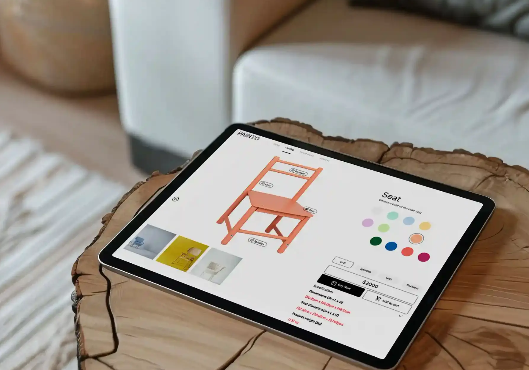
This is where the 3d configurator has become such a valuable tool for furniture brands specifically. Instead of scrolling through a limited set of pre-shot photos, customers can now select their own combination of fabric, wood finish, dimensions, and layout, watching a live model update instantly with each choice. Rather than trying to imagine how a certain fabric might look on a particular frame style, they see it rendered directly in front of them.
This shift changes the entire shopping experience from passive browsing to active participation. A customer configuring a sectional sofa might spend ten or fifteen minutes adjusting the layout, testing different fabric swatches, and comparing leg finishes before settling on a final combination. That time investment matters. By the time someone finishes building their ideal version of a piece, they’ve developed a much stronger sense of ownership over that specific configuration than they ever would from simply liking a photo of a showroom display.
Furniture brands have also found that configurators help address one of the more subtle challenges in this category: helping customers understand scale and proportion. Selecting the right size sofa for a particular room, or the correct dimensions for a dining table that needs to seat a certain number of people, is difficult to judge from a photo alone. Interactive tools that let customers adjust dimensions and see the resulting model update in real time make this kind of practical decision-making far more intuitive than static size charts ever could.
Why Visual Accuracy Is Especially Important for Furniture
None of this works without convincing, accurate rendering behind it, which is why 3d visualization plays such a central role in furniture e-commerce specifically. Fabric texture, wood grain, and finish quality all carry significant weight in a furniture purchase decision, and if a rendered preview looks flat or unconvincing, customers lose confidence quickly.
Good visualization needs to replicate how light interacts with different materials realistically. A velvet upholstery option needs to show its characteristic sheen and texture, while a matte linen finish needs to look appropriately soft and textured by comparison. Wood finishes need to reflect grain patterns and stain tones accurately enough that customers can tell the difference between similar shades. When this level of detail is handled well, it goes a long way toward replicating the kind of tactile confidence customers would normally only get from touching a fabric swatch or seeing a piece in a physical showroom.
This accuracy has a direct financial impact as well. Furniture is one of the more expensive and logistically complicated categories to process returns for, given the size and weight of most pieces. When customers can trust that what they see in a configurator closely matches what will actually arrive, brands see meaningfully fewer returns driven by mismatched color or texture expectations, which translates into real savings on reverse logistics.
Personalization Beyond Standard Configuration
Some furniture brands have pushed even further into personalization with tools sometimes referred to as a 3d customizer, which allow for more flexible input beyond a defined set of configuration choices. This might include custom sizing for built-in furniture, personalized engraving on wood pieces, or the ability to mix and match components in ways that go beyond a brand’s standard offerings.
This deeper level of personalization tends to appeal strongly to customers furnishing spaces with unusual dimensions or specific design requirements, such as custom-built shelving units or made-to-measure sofas for awkward room layouts. Building a reliable customizer for these situations is more technically demanding than a standard configurator, since the system needs to validate that custom dimensions and combinations remain structurally sound and manufacturable, while still giving customers the flexibility that drew them to a custom option in the first place.
Brands that get this balance right often find that customers pursuing this level of personalization are also some of their most loyal, since they’ve had a direct hand in creating a piece that fits their specific needs in a way that off-the-shelf furniture simply couldn’t.
The Business Case Furniture Brands Are Responding To
The investment furniture brands are making in these tools isn’t happening in a vacuum. It’s a direct response to measurable business outcomes. Retailers who have implemented configuration and visualization tools consistently report longer time spent on product pages, since customers naturally engage more deeply when they’re actively building a product rather than passively scrolling past it. That engagement tends to correlate with stronger conversion rates, since a customer who has already invested time designing their ideal piece is significantly more likely to follow through with a purchase.
Return rates, as mentioned earlier, tend to improve as well, which matters enormously in a category where return shipping and restocking costs can be substantial given the size of most furniture items. Fewer mismatched expectations mean fewer costly reverse logistics situations, which has a direct and measurable impact on profitability.
There’s also a competitive dimension at play. As more furniture brands adopt these tools, customers increasingly expect them as a standard part of the shopping experience. A brand still relying solely on static photography and simple dropdown menus risks feeling outdated compared to competitors offering a richer, more interactive way to shop, even if the underlying product quality is comparable.
The Investment Required to Do This Well
Building accurate configuration and visualization tools isn’t a small undertaking, particularly for furniture brands with extensive product catalogs. Every fabric, finish, and structural variation needs to be modeled and rendered accurately, and that modeling work needs to stay current as materials change or new options are introduced. A brand that switches fabric suppliers or updates a finish needs its digital models updated in step, or customers risk configuring something that no longer matches what’s actually available.
Performance also matters a great deal, especially since a growing share of furniture shopping happens on mobile devices. A configurator that looks impressive on a desktop but loads slowly or feels awkward on a phone will frustrate customers rather than draw them in, undermining the very engagement the tool was designed to create.
Where This Is Headed for the Furniture Industry
As rendering technology continues to become more efficient and affordable, it’s likely that these tools will extend even further into the furniture buying process, potentially including augmented reality features that let customers place a configured piece directly into their own room to check scale and fit before ordering. Some brands are already exploring this, and it represents a natural next step for a category where spatial fit is such a central part of the purchase decision.
What’s clear is that furniture brands investing in interactive configuration aren’t chasing a passing trend. They’re responding to a genuine shift in how customers want to shop for pieces that are expensive, highly variable, and deeply personal to the spaces they’ll occupy. For an industry that has always struggled with the limitations of static product photography, giving customers the ability to see, build, and trust exactly what they’re buying has become one of the clearest paths toward reducing returns, increasing conversions, and meeting expectations that customers now carry with them from nearly every other category they shop in online.